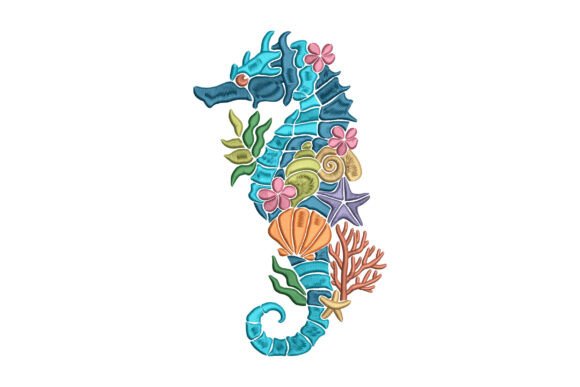
Floral Seahorse Embroidery
First Impression: Bold, Whimsical, and Instantly Memorable
As an embroidery designer who’s prepped over 200 craft fair booths—from Portland pop-ups to Nashville handmade markets—I opened the Floral Seahorse Embroidery file and felt that rare spark: a design that balances wildlife authenticity with decorative charm. It’s not cutesy or cartoonish—it’s bold, detailed, and quietly sophisticated. Think coastal boutique meets botanical illustration, not aquarium souvenir. That duality makes it stand out in a sea of generic florals or over-simplified marine motifs. Customers scanning your booth won’t just glance—they’ll pause, lean in, and ask, “Is that *hand-drawn*?” That’s your opening line.
Where It Shines: Craft Fair-Ready Product Pairings
This Floral Seahorse Embroidery design thrives where contrast and storytelling intersect. On a natural linen tote bag? Stunning—its 4.01″ x 3.99″ size anchors the front panel without overwhelming. On a chef’s apron? Perfect for the chest pocket or lower left corner—adds personality without compromising function. For tea towel embroidery, it reads clearly even when folded on a market rack, especially against oat, sage, or indigo-dyed cotton. And as an embroidered patch? Ideal—clean outer edge, balanced negative space, and enough detail to justify a $12–$16 price point.
It also elevates small-shop products that need instant visual lift: fabric pouches (centered on the flap), pillow covers (top-third placement), and structured caps (front panel, scaled to ~3.5″ wide). Avoid placing it directly on curved cap crowns unless you’ve tested stitch tension—more on that below. As a machine embroidery design, it’s equally effective as a focal point on market bags or a subtle accent on handmade gift tags paired with dried lavender bundles.
Real-World Production Notes You Can’t Skip
At 20,195 stitches, this Floral Seahorse Embroidery file sits in the “detailed but doable” range—not overly dense like photorealistic portraits, but rich enough to reward close inspection. That said, here’s what I checked before committing to 50 tote bags:
- Stitch density hotspots: The floral tendrils wrapping the seahorse’s tail and the inner petal layers show tighter fill areas. Test on medium-weight twill first—don’t skip cutaway stabilizer, especially for tea towel embroidery where fabric texture can distort fine lines.
- Scale flexibility: Works cleanly at both listed sizes (4.01″ and 5.01″), but avoid shrinking below 3.25″—the seahorse’s eye and stem details blur. No tiny lettering or micro-motifs to worry about, which is a huge plus for batch production.
- Fabric compatibility: Performs beautifully on smooth cotton, linen blends, and quilting weight—but tread carefully on terry cloth towels or heavy canvas. The design’s balance means it won’t “sink” into texture, but thread pull can occur if stabilizer isn’t layered correctly.
- Dark fabric readiness: Designed for contrast—pair deep navy or charcoal with ecru or pale gold thread. Avoid black-on-black unless using metallic or high-sheen rayon for definition.
Selling Power: Booth Impact, Online Appeal, and Brand Alignment
In person, Floral Seahorse Embroidery draws attention without shouting. At a crowded craft fair, it reads as *premium handmade*, not DIY kit energy. That perception lifts perceived value—customers happily pay more for pieces featuring it, especially when paired with quality materials (e.g., organic cotton aprons, heavyweight linen pouches). It strengthens booth cohesion too: use it across three product types (tote + patch + pillow cover) and your display feels intentional, not scattered.
For Etsy sellers and digital sellers, this embroidery file photographs exceptionally well. Its clear silhouette and organic flow translate crisply in flat-lay shots and lifestyle mockups—even on printable mockup templates. No awkward cropping needed. And because it avoids trends (no neon gradients or retro fonts), it stays relevant across seasons—ideal for small shop product catalogs you update quarterly.
Designer-to-Designer Must-Do Checks
Before cutting your first production run, do these six things:
- Run a test on scrap fabric matching your final product—same thread colors, same hoop size, same stabilizer combo.
- Check thread contrast under daylight *and* warm bulb light—some ecru threads gray out on cream linen indoors.
- Review spacing between floral elements and seahorse outline—tight gaps can merge during stitching if tension isn’t dialed in.
- Confirm hoop size compatibility—this design fits comfortably in a 5″ x 7″ hoop, but verify your machine’s max stitch area.
- Inspect stitch direction in the fill areas—consistent grain improves sheen and reduces skipped stitches on textured surfaces.
- Create at least one real-world mockup (not digital): stitch it onto your actual tote fabric, hang it on a booth display hanger, and walk away then return—does it still catch your eye?
And crucially: confirm commercial licensing terms. This Floral Seahorse Embroidery file is marketed for wildlife lovers and statement projects—but if you’re selling finished goods at a craft fair or online, ensure your license covers commercial embroidery use. When in doubt, contact the designer or platform directly. Never assume.
Final Thought: A Strategic Design Asset, Not Just a Pretty File
The Floral Seahorse Embroidery isn’t just another fish-themed embroidery file—it’s a versatile, mood-driven design asset. It bridges nature lovers and modern makers, appeals across age groups, and performs consistently across product categories. For Etsy sellers building cohesive collections, boutique makers curating seasonal launches, or Cricut crafters expanding into machine embroidery, it’s a low-risk, high-return addition. In a market saturated with generic florals and overused animals, this design stands apart—not because it’s loud, but because it’s thoughtfully composed, commercially smart, and quietly unforgettable.