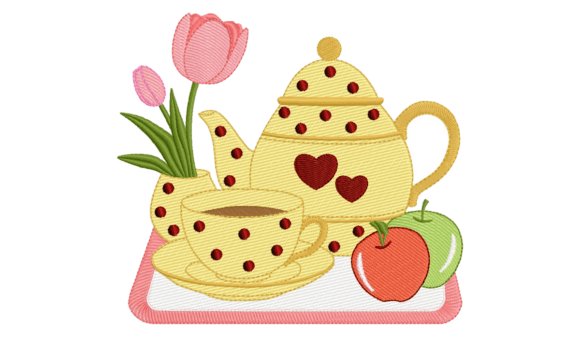
Teapot and Cup Machine Embroidery
First Impression: Charming, Cohesive, and Instantly Recognizable
As an embroidery designer who’s prepped over 200 craft fair booths in the past decade, my first reaction to Teapot and Cup Machine Embroidery is immediate: it reads as warm, intentional, and market-ready. The title alone cues a clear theme — tea — without leaning into cliché or clutter. Combined with the description — “a charming tea set with a teapot, cup, tulips, and apples on a tray” — this isn’t just another floral motif. It’s a curated still life, rich with narrative and domestic charm. Customers at handmade markets don’t pause for abstracts; they stop for stories. This design tells one in under three seconds: comfort, hospitality, and quiet elegance. It lands somewhere between farmhouse and refined — not too fussy for modern kitchens, not too minimal to feel impersonal.
Where It Shines: Craft Fair Product Placement That Converts
In my booth setup, I always lead with tactile, high-visibility items. Teapot and Cup Machine Embroidery performs exceptionally well on kitchen towels — especially linen-cotton blends — where the tray base anchors the composition and the tulips add vertical lift. On aprons, it works best centered just below the pocket (not chest-high), letting the teapot pour visual weight downward toward the waistband. As a tote bag design, it holds up beautifully when scaled to 4.5–5 inches wide — large enough to read from six feet away, small enough to avoid overwhelming the canvas. For embroidered patches, I’d recommend using it as a full-tray motif (not cropped) so the apples and tulips remain legible at 3 inches. On pillow covers and fabric pouches, it adds giftable polish — particularly when stitched in muted sage, cream, and terracotta thread colors that echo artisan ceramics and dried florals.
What Doesn’t Work — And Why
- Caps: Avoid curved surfaces unless you’re using a specialized cap hoop and low-density fill. The tray’s flat geometry fights the dome shape, and tiny apple stems risk distortion.
- Dark fabric without contrast testing: Tulip petals and teacup handles can disappear on charcoal or navy without high-contrast thread choices — test before cutting yardage.
- Textured terry cloth towels: High stitch density in the teapot spout or tulip centers may pucker or sink. Use cutaway + tear-away stabilizer combo, not lightweight only.
- Under 3 inches: Apples lose definition, tulip stamens blur, and the tray’s subtle shadowing flattens. Not ideal for tiny keychain patches or collar accents.
Production Realities: Speed, Clarity, and Batch-Friendly Flow
This machine embroidery design is inherently batch-friendly — no overlapping elements, no nested lettering, no micro-details requiring manual thread changes. The layout is open and breathable: negative space around the tray lets stitches settle cleanly, reducing tension issues across varied fabric types. That spacing also makes it forgiving for slight alignment shifts during hooping — critical when embroidering 40+ tea towel designs back-to-back at fair prep time. Photographically, it renders beautifully for Etsy listings: natural light highlights the dimensional fill in the teapot body, while the tulips’ satin-stitch curves translate well to printable mockups. As a digital embroidery file, its visual clarity means customers rarely message asking “Which part is the cup?” — saving time for small shop owners managing multiple platforms.
Design Assets That Build Brand Consistency
When I build a cohesive craft fair line, I treat each embroidery file as a modular brand asset. Teapot and Cup Machine Embroidery pairs seamlessly with neutral linens, unbleached cotton, and oatmeal canvas — reinforcing a handmade, ingredient-conscious aesthetic. Its balanced composition (horizontal tray, vertical tulips, grounded apples) creates rhythm across diverse products: a matching set of embroidered market bags and pillow covers feels intentional, not repetitive. Buyers notice that. They’ll pick up the tea towel *and* the pouch because the motif feels like part of a considered collection — not a one-off clipart addition. That perceived cohesion lifts perceived value, especially among boutique makers pricing for craftsmanship over craftiness.
Must-Do Designer Checks Before Production
- Test the machine embroidery design on scrap fabric matching your final product — especially if using textured tea towels or structured apron twill.
- Verify thread contrast: run a sample with light thread on dark fabric and vice versa. Tulip centers and apple highlights need separation to read.
- Review spacing between elements — ensure the teapot handle doesn’t stitch too close to the cup rim, risking thread bridging.
- Confirm hoop size compatibility with your machine and intended product (e.g., a 5x7 hoop fits most apron pockets; larger hoops may require re-hooping).
- Inspect stitch density in the teapot’s lid and tulip calyx — dense fills may require slower speed or heavier stabilizer.
- Use appropriate stabilizer: medium-weight cutaway for stable fabrics; cutaway + tear-away hybrid for stretchy or napped surfaces.
- Create at least one real mockup — not just a digital preview — to assess how light hits raised satin stitches in person.
- Compare thread colors across fabric swatches: ivory thread reads warm on natural linen but cool on bleached cotton.
- Confirm commercial licensing applies to finished products — essential for Etsy sellers and wholesale partners.
Final Thought: A Quiet Standout in a Busy Booth
At craft fairs, loudness competes with clutter. Teapot and Cup Machine Embroidery wins by being quietly confident — detailed enough to reward a second look, simple enough to land instantly. It doesn’t shout “tea!” — it invites conversation about morning rituals, handwritten notes tucked under mugs, or the way tulips lean toward windowsills. That emotional resonance, paired with smart production flexibility, makes it more than a machine embroidery design. It’s a reliable craft fair product engine — one that turns curious browsers into repeat buyers, and handmade goods into meaningful keepsakes.