Anatomical Heart Embroidery Design
First Impressions: Clinical Clarity Meets Quiet Warmth
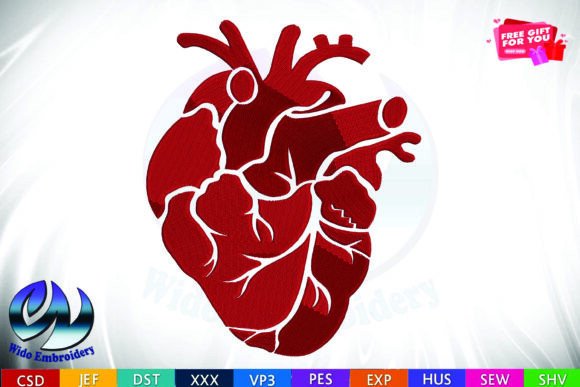
When I opened the Anatomical Heart Embroidery Design, I didn’t see a cliché valentine or cartoon organ—I saw something grounded, intentional, and quietly expressive. The layout balances anatomical accuracy with embroidery-friendly flow: clear chambers, subtle valve hints, and clean outer contours—no unnecessary micro-details that would vanish in satin stitch or snag on stabilizer. It doesn’t shout “medical textbook”; instead, it whispers “thoughtful craft.” That duality makes it unexpectedly versatile—not just for scrubs or clinic merch, but for boutique baby blankets, minimalist aprons, or even a refined holiday gift for a nurse or med student.
A Real Project Test: Custom Tote for a Pediatric Clinic Pop-Up
Last month, I used the Anatomical Heart Embroidery Design on a natural canvas tote for a local pediatric clinic’s community fair. We chose the medium size (4.2″ wide) in a single-tone navy thread on oat-colored fabric. Why? Because clarity mattered more than flash. Parents paused at the booth—not to read a logo, but to recognize the quiet dignity of the shape. One mom said, “It feels like care, not charts.” That’s the design’s strength: it communicates empathy without sentimentality. As a machine embroidery design, it stitched cleanly on mid-weight canvas with tear-away + light cutaway stabilizer—no puckering, no skipped stitches, and the satin-stitched outer edge held crisp definition across curves.
Where It Shines—and Where It Needs Thought
This isn’t a one-size-fits-all embroidery file. Its performance shifts meaningfully across materials and applications:
- Custom apparel: Works beautifully on sweatshirts and structured tees—but avoid ultra-thin jersey or heavily brushed fleece unless you pre-test stitch density and stabilizer pairing. The fill stitch areas are dense enough to hold shape but not so heavy they crack on stretchy fabric.
- Tote bag design & pillow covers: Ideal. The clean silhouette reads well at arm’s length, and the balanced proportions scale gracefully from small (2.5″) to large (6.8″) without distortion.
- Baby embroidery & nursery decor: Choose the smaller sizes (2.5″–3.5″) and soft pastel threads. Avoid tiny lettering additions—the design’s integrity lies in its uncluttered anatomy, not labels.
- Embroidered patch & cap embroidery: Proceed with caution on curved surfaces. The top arch and lower apex need precise hooping; test on scrap caps first. For patches, use the applique version if included—it adds dimension while keeping edges tidy.
- Holiday embroidery & personalized gifts: Pair it with simple monograms or dates (e.g., “Est. 2024” beneath) for wedding or graduation gifts. It reads as meaningful, not generic—especially on tea towels or linen napkins where subtlety wins.
Design Integrity in the Finished Product
What elevates the Anatomical Heart Embroidery Design beyond novelty is how it supports your brand voice—whether you’re an Etsy seller listing handmade scrubs, a small shop product curator, or a craft business creating custom nurse gifts. It avoids visual noise, so your stitching quality stays center stage. Customers notice clean edges, consistent satin stitch sheen, and confident proportions—not “busy” filler. That builds trust: when a buyer sees this on a $75 embroidered apron, they feel the care behind the handmade product. It also scales well into printable mockups for digital listings—clean lines translate crisply to screen, helping buyers visualize the final finished product.
Practical Designer Notes You Can’t Skip
Before committing to client work or bulk production, here’s what I always do:
- Test on scrap fabric—especially if using textured, dark, or layered material. What looks sharp in software can blur on terry cloth or heather grey.
- Check thread color contrast carefully. This design relies on contour definition, so low-contrast combos (e.g., light grey on charcoal) lose impact.
- Review stitch density in your embroidery software. If the fill areas feel overly heavy for lightweight fabrics, reduce density by 5–8%—don’t guess.
- Confirm hoop size for your chosen size. The largest version may require a 6×10 hoop—verify before loading.
- Inspect small details at actual stitch size: valve lines, chamber separations, and outer curves should remain distinct, not merge into blobs.
- Test black-and-white mockups—this design gains strength in monochrome. If it reads clearly without color, you’re golden.
- Use proper stabilizer: Light cutaway for knits, tear-away for stable wovens, and fusible + tear-away for quilting cottons.
- Verify licensing before selling finished items or bundling the digital embroidery file with other design assets. Commercial use rights aren’t automatic—even for medical-themed applique design.
Fitting Into Your Workflow—Not Just Your Hoop
As a working designer, I value embroidery files that respect my time *and* my standards. The Anatomical Heart Embroidery Design does both: it’s detailed enough to feel authentic, but edited enough to stitch reliably across machines and materials. It fits naturally into commercial embroidery workflows—no re-digitizing needed for standard apparel or home goods—and works equally well for limited-run boutique branding or high-volume custom apparel orders. For creative entrepreneurs, it’s a smart Work-category asset: professional without stiffness, distinctive without distraction, and human-centered without being cutesy.
The Bottom Line for Makers Who Ship Real Things
If you’re choosing embroidery designs for products people hold, wear, gift, or keep—this one earns its place. It’s not flashy, but it’s memorable. Not trendy, but it endures. And unlike many anatomy-themed files, it avoids clinical coldness by honoring proportion, rhythm, and restraint. Whether you’re stitching a nurse’s holiday sweater, a med-school grad’s tote, or a heartfelt baby blanket, the Anatomical Heart Embroidery Design delivers quiet confidence—both in the hoop and in the hand.