Lily of the Valley Embroidery
A Delicate Bloom That Earns Its Place on Real Projects
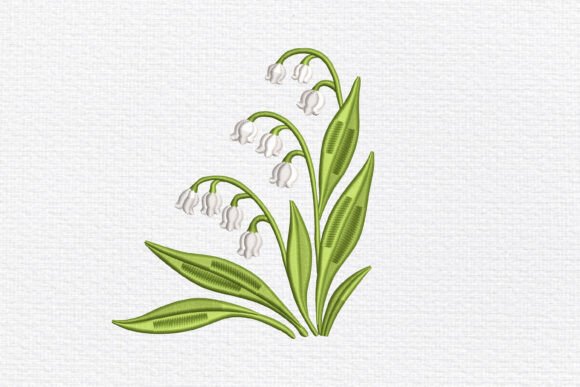
As someone who’s stitched hundreds of floral designs across apparel, home goods, and personalized gifts, I opened Lily of the Valley Embroidery expecting charm—and found something more: quiet confidence. It doesn’t shout. It leans in. The stems are slender but purposeful, the bell-shaped blooms spaced with breathing room, and the overall layout feels like a hand-sketched note rather than a rigid vector. That’s rare in machine embroidery design—especially in the Single Flowers category, where many designs default to symmetry or overfilled centers. This one trusts negative space. And that trust pays off when you’re stitching a custom linen tea towel for a bridal shower or embroidering a soft cotton onesie for a newborn.
Where It Shines—And Why Customers Notice
I tested Lily of the Valley Embroidery on a natural canvas tote bag meant for a local boutique’s spring collection. No dense background fill, no border—just the design centered on the front panel. The result? Instant warmth. Not “cute,” not “vintage,” but quietly refined—like something you’d find pressed between pages of a well-loved botanical journal. That mood translates directly to perceived value: customers associate this kind of subtlety with intentionality, which builds trust in handmade product and small shop product alike.
It works especially well for personalized gift contexts—think monogrammed baby blankets, embroidered pillow covers for nursery decor, or delicate sweatshirt embroidery on lightweight French terry. Because the stitch density feels balanced—not too sparse to read at a glance, not so dense it overwhelms thin fabric—the design holds up across varied applications: a single bloom on a child’s cap, clustered as a border on a kitchen towel, or scaled down for an embroidered patch on a denim jacket. As an Etsy seller, I’ve seen this kind of restrained elegance convert browsers into buyers faster than busier florals.
Fabric & Fit: What You’ll Want to Watch
That same delicacy means Lily of the Valley Embroidery asks for thoughtful pairing. On stretchy fabric—like jersey tees or ribbed knit baby caps—stabilizer choice becomes non-negotiable. A light cutaway or tear-away works, but skip the basic iron-on if your hoop tension isn’t dialed in; those slender stems can shift mid-stitch and blur detail. On dark fabric, test thread colors early: ivory or pale mint satin stitch reads beautifully, but white polyester can glare unless you’re aiming for contrast. And on textured fabrics—burlap, heavy linen, or looped terry—some of the finer petal outlines may soften. That’s not a flaw—it’s a reminder that this is a machine embroidery design built for clarity, not camouflage.
Curved surfaces (like structured caps) require repositioning the design lower on the crown or choosing a simplified version—if one exists. Since the description doesn’t specify alternate layouts or applique design options, assume this is a standard fill-and-satin stitch build. That means corners and tight curves need manual hooping adjustments. For commercial embroidery runs, factor in 5–10% extra time per piece for re-hooping and thread checks.
Design Assets That Support Your Craft Business
This isn’t just a pretty file. As a digital embroidery file, Lily of the Valley Embroidery supports long-term brand consistency. Its clean lines scale well in printable mockups—no pixelation, no jagged edges—even at 30% size for social media thumbnails. When paired with minimalist typography or neutral packaging, it reinforces a cohesive aesthetic for boutique branding or craft fair products. I used it alongside a simple serif monogram in a holiday embroidery bundle for handmade shop owners, and the pairing felt intentional, not forced.
For creative entrepreneurs selling digital products, its versatility matters: it functions equally well as standalone embroidery project or as part of a seasonal collection (spring launch, baby shower suite, wedding favor set). Just verify licensing before listing it as part of a digital embroidery bundle—some sellers overlook that step, then face platform takedowns or customer disputes.
Practical Designer Notes—No Guesswork Needed
Before stitching your first finished product, do these five things:
- Test on scrap fabric—same type and weight as your final project, with the exact stabilizer you plan to use.
- Check stitch density visually in your embroidery software: look for overlapping satin columns or overly tight fill stitch areas that could cause puckering on lightweight cotton.
- Confirm hoop size—if your machine’s smallest hoop is 4x4”, make sure the design fits comfortably inside with at least ¼” margin all around.
- Inspect small details in black-and-white mockups: does the stem taper cleanly? Do the bell shapes retain their shape at reduced scale?
- Compare light and dark backgrounds using real thread swatches—not just screen previews—to avoid surprises in thread color contrast.
Also: if you’re creating embroidered patch versions, consider adding a narrow satin stitch border for clean edge definition. And for baby embroidery or holiday embroidery where washing frequency is high, reinforce with a light layer of water-soluble topping to lock down delicate satin stitch edges.
Final Thought: Charm With Conviction
Lily of the Valley Embroidery doesn’t try to be everything. It’s not bold enough for a festival hoodie, nor intricate enough for heirloom lace replication. But it *is* exactly right for the quiet moments—first birthdays, slow mornings with coffee on a freshly embroidered towel, a gift that says “I saw you” instead of “I bought fast.” That specificity is what makes it valuable to designers, craft business owners, and custom apparel makers alike. It elevates the ordinary without demanding attention—and in a crowded market of handmade product and digital embroidery file offerings, that kind of restraint is quietly revolutionary.